BizPlans
Worm castings business in Kenya: costs and buyers
Kenya-first insights, practical and grounded.
Published 29/10/2026 - 4 min read
Worm castings business in Kenya: costs and buyers
Start with repeat castings sales and the fully costed delivery route, then decide whether a pilot deserves more money.
Executive summary: earn the delivery radius
Build the first business case around repeat castings sales to buyers you can serve at a fully costed delivery point. Treat breeding stock and vermi-tea as separate, optional businesses. A stream of new worm farmers is not evidence of repeat demand for castings. The workbook therefore calculates its base operating result without breeding-stock or liquid sales. It asks for your own measured weights, costs and offers before showing a usable result.
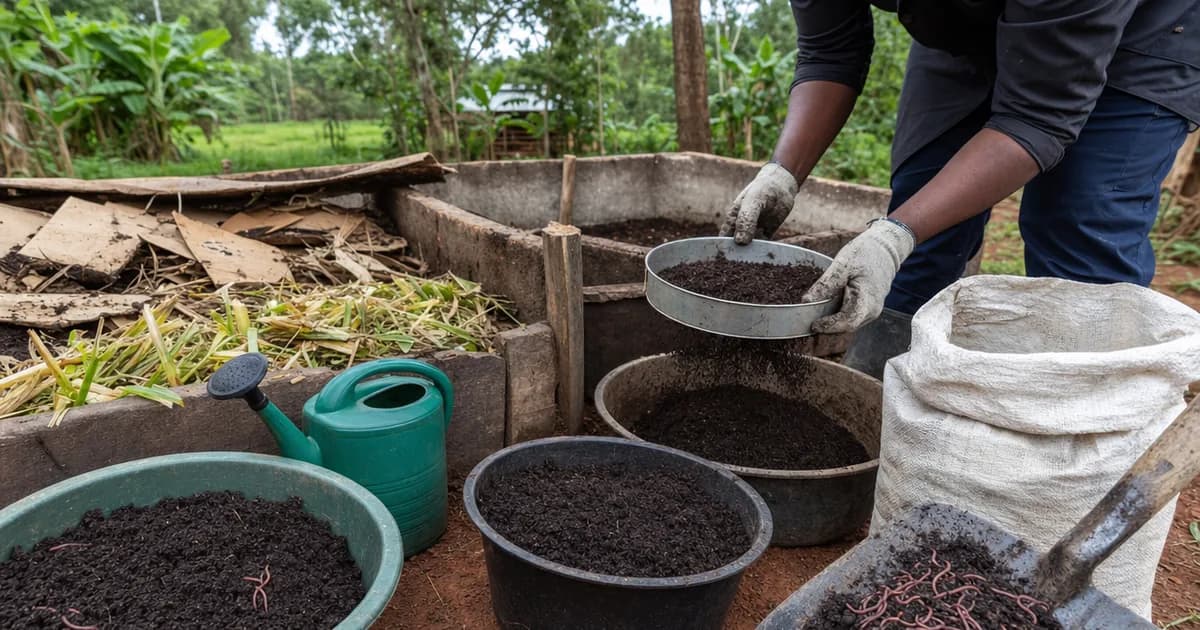
This is a planning kit for a Kenyan smallholder or landless operator considering a vermicomposting unit. The supplied operator reporting describes red wigglers, organic inputs, castings, breeding stock and liquid products, but does not establish a transferable yield or business margin. [S4][S5][S6] Use the guide to organise a pilot and a decision, rather than to copy another operator's scale.
Your first deliverable is a dated evidence folder: a written Board enquiry about the exact product description, local buyer conversations, feedstock arrangements, site questions and transport quotations. The legal definition makes naming a regulatory question. It does not establish your exemption. [S1][S2] If the evidence is missing, the proper result is needs input.
Feedstock Plan: the cost of free waste
Request a written arrangement for each proposed manure, crop-residue or market-waste source. Record the source, material description, expected collection quantity, collection days, price basis and who loads it. Ask what happens when material is unavailable or unsuitable for your intended process. The supplied evidence leaves local availability and volume open; it does not promise free or reliable inputs. [S4][S5]
In Feedstock Plan, enter kilograms, purchase price per kilogram, collection and transport, loading or handling cash, and owner-time value separately. Each row calculates purchase cost, full landed cash cost and full economic cost. A zero purchase price still requires the collection and handling amounts. Missing transport must keep the landed result at needs input. Do not use a donated material description as permission to enter a zero total cost.
Keep the cost period aligned with the castings cycle being assessed. If one collection supplies several cycles, document the allocation by measured quantity and retain the trip receipt. Do not put the same collection charge into both Feedstock Plan and the general cycle-cost rows. Record the allocation reference so you can check the complete route from source to bed.
Validate demand through at least five dated conversations
Use at least five dated buyer conversations as your first evidence exercise. Ask each contact about product form, inspection, pack weight, trial quantity, repeat timing, named delivery point, payment terms and rejection arrangements. Ask permission to keep a written summary and send it back for correction. A conversation is evidence of what was said, not a confirmed order or customer relationship.
Choose possible contacts from nurseries, landscapers, growers and garden centres within a radius you can quote for. These are prospective buyer categories from the evidence brief's open questions, not a customer list. [S4][S8] Record the travel or delivery requirement even when the conversation ends without a price. A refusal can identify a cost or specification you have not considered.
After the first round, separate interested, trial requested, written offer received, delivered, paid and repeat purchased. Only describe the status actually supported by records. Revisit interested contacts after a proposed trial, and record what changed. Expansion needs a reasoned comparison of measured output, completed sales and collected cash. It cannot be justified by five names in a contact sheet or an operator story from another county.
Your next evidence step
Keep unknown costs and weights blank until you have a record. Ask for at least five dated buyer conversations and a transport quote for the actual load. Interest is not an order; a harvest is not cash collected. Compare castings-only operating costs before adding optional breeding-stock or liquid sales. No vermicompost price in this kit is a market price.
Use the guide, printable worksheets and editable workbook to organise your own evidence.
Last verified: 29 October 2026.
Sources
- [S1] Fertilizers and Animal Foodstuffs Act, Cap. 345
- [S2] Fertilizers and Animal Foodstuffs (Approved Fertilizers) Rules
- [S4] Wealth in worms: How George built a thriving organic fertiliser business
- [S5] The power of worms: Meet farmers transforming organic waste into wealth
- [S6] Jannifer Muthike in insect farming
- [S8] Vermi-compost retail listing
- [S9] Site environmental enquiries
Business startup decision checklist
A free checklist to turn the next decision into a practical action.
More insights
Use the full model
Related downloadable guides
Farm the Unfarmed
Compare small-space ventures before you invest
Compare costs, production risks and buyer requirements for insects, worm castings, mushrooms and culinary herbs. Verify local demand and record your own evidence before starting a pilot.