Loading page
BizPlans
Watermelon Farming Business Plan in Kenya: One-Acre Costs, Market, and PDF
Kenya-first insights, practical and grounded.
Back to insights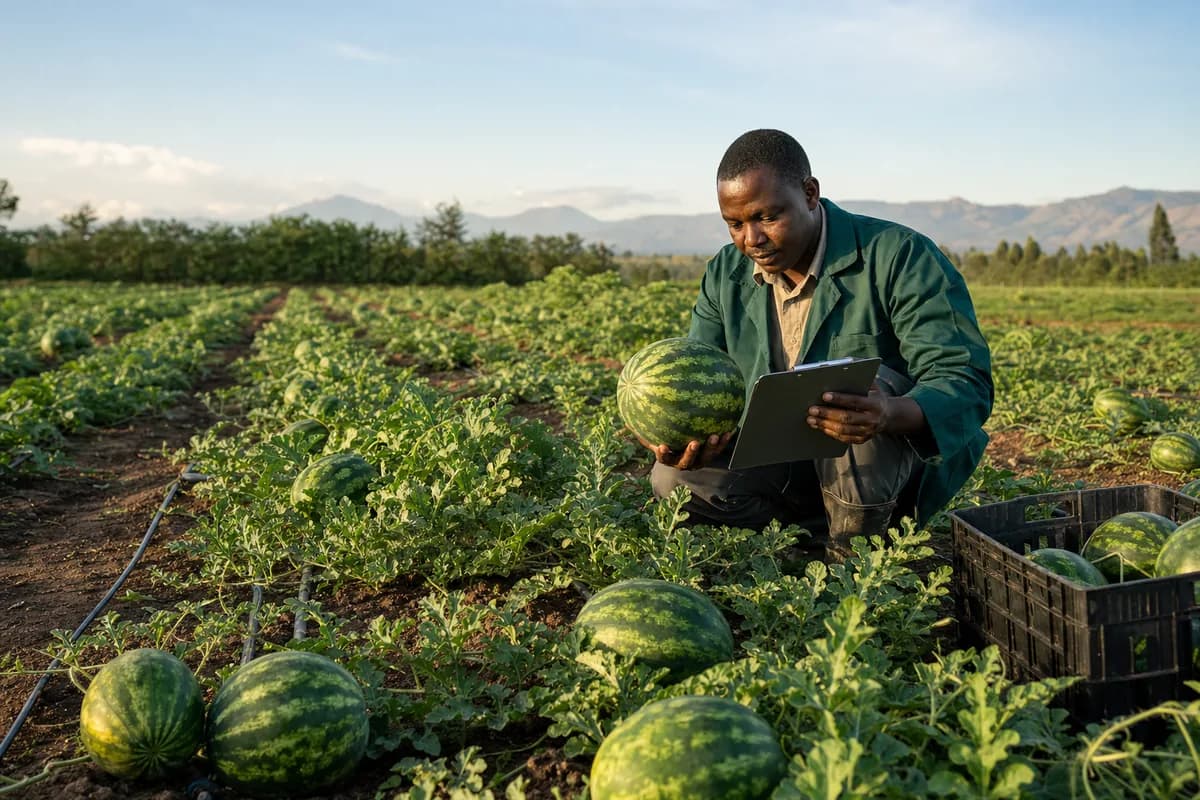
Published 30/07/2026 - 3 min read
Watermelon Farming Business Plan in Kenya: One-Acre Costs, Market, and PDF
Watermelon is a market-sensitive crop. A credible business plan must connect the production site, water, variety, crop calendar, pest and disease management, labour, harvesting, transport, buyers, and complete-cycle cash.
For a ready document, see the One-Acre Watermelon Farming Business Plan for Kenya. For projections based on your county, water source, quotations, and buyer terms, use the custom business plan builder.
Confirm site suitability first
Before budgeting, confirm the site's agro-climatic fit with a qualified extension or agronomy resource. KALRO's melon training material explicitly advises users to verify site-specific details for their agro-climatic zones with local agricultural extension officers.
Record:
- Soil and drainage condition
- Reliable water source and pumping cost
- Irrigation layout
- Variety and seed source
- Planting window
- Crop-protection plan
- Labour availability
- Access road and transport
- Target harvest window
A national template cannot confirm whether a specific field is suitable.
Budget the complete cycle
Include land preparation or lease, soil testing where appropriate, seed, manure and fertilizer, irrigation, crop protection, labour, harvesting, grading, crates or protective handling, transport, market charges, losses, and working capital.
Obtain current quotations from more than one supplier. Avoid copying a social-media cost figure unless its acreage, date, location, irrigation, labour, and included items are clear.
Separate reusable assets—such as a pump, tank, or mainline—from crop-cycle expenses. This prevents double counting and makes the cash-flow requirement visible.
Plan the market before planting
Potential buyers include traders, aggregators, retailers, fresh-produce shops, institutions, hospitality businesses, and direct customers. Ask buyers how they grade fruit, whether price is per fruit or by weight, acceptable size, collection responsibility, deductions, and payment timing.
Watermelon is bulky and timing matters. A headline market price is not the amount retained by the farmer. Model the net farm amount after transport, market fees, commission, damaged fruit, rejects, and delayed payment.
Secure several buyer options. One expression of interest is not enough for an acre of perishable produce.
Use conservative scenarios
Build downside, base, and upside cases using saleable yield, realised net price, losses, and costs. The downside case should test lower saleable output, weaker price, higher transport, and a harvest delay.
Do not calculate revenue from every planted seed. Base the model on saleable output after field and grading losses. Replace planning assumptions with actual field records after the first crop.
Production and harvest controls
Use current, locally appropriate technical guidance for variety choice, crop nutrition, irrigation, pests, diseases, pesticide use, pre-harvest intervals, and worker safety. Keep input labels, purchase records, application records, scouting notes, and harvest records.
KALRO material identifies visual maturity indicators including changes in the tendril near the fruit stem and the ground spot. Harvest decisions should still follow the selected variety and qualified local guidance rather than a single generic sign.
Frequently asked questions
Is one-acre watermelon farming profitable in Kenya?
It can be, but profitability depends on saleable yield, net price, water, crop management, harvest timing, transport, and buyer access. Test current local evidence rather than relying on a universal profit claim.
Which county is best?
There is no single answer. Suitability depends on the exact site's climate, soil, drainage, water, disease pressure, infrastructure, and market route. Seek site-specific extension advice.
Where is the PDF?
The One-Acre Watermelon Farming Business Plan for Kenya is a paid downloadable guide with a sample option on the product page.
Sources
- KALRO climate-smart melon training manual
- KALRO Sustainable Agricultural Livelihood Restoration training manual
- Kenya Meteorological Department
- KRA eTIMS
Source check: 30 July 2026. Prices, yields, permits, and buyer terms vary; verify current local evidence before investing.
Funding preparation checklist
A free checklist to turn the next decision into a practical action.
More insights
Use the full model